tdMagazine was designed for online magazines, personal blogs, and news sites that needed several ways to organize important stories. Its original homepage combined a breaking-news strip, featured content, category-based post widgets, multiple archive layouts, visual customization, social links, custom templates, and a large navigation menu.
Editorial emphasis
Breaking-news and featured-content areas placed priority stories before the standard post feed.
Category sections
Homepage widgets could display posts from all content or from selected categories.
Layout choices
The original theme promoted several blog and widget arrangements for different content volumes.
Publication navigation
Archive, author, 404, and mega-menu features supported larger editorial websites.
Breaking News section
The original Breaking News area appeared at the top of the page and displayed linked post or page titles. It was intended for urgent updates, major announcements, or content that needed temporary prominence without replacing the main featured story.
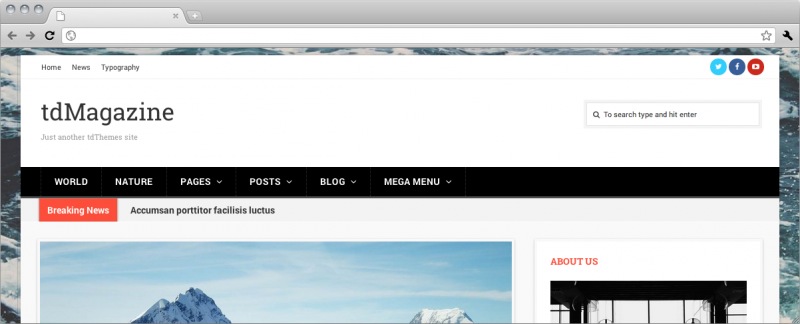
Use an urgent-news area sparingly. Reserve it for genuinely time-sensitive information, keep labels specific, and remove old notices once they are no longer important. A permanently animated or overloaded ticker can make a publication harder to scan.
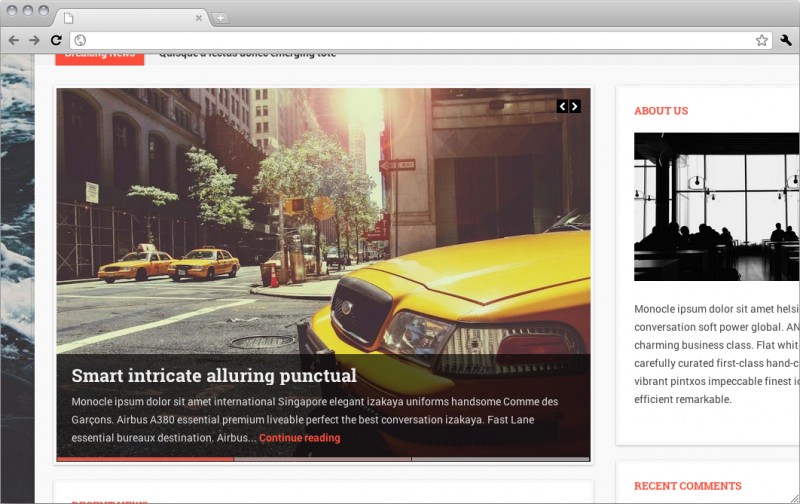
Featured content slider
tdMagazine’s featured area displayed selected posts with the featured image, headline, excerpt, and link. The original configuration was controlled through post settings so editors could decide which stories received the largest visual treatment.
Homepage-specific post widgets
The custom homepage widget area could display posts from the full blog or a selected category. Editors could set a section title, choose how many posts appeared, and use recent, random, or popular ordering. The source article described two primary widget styles: Standard and Columns.
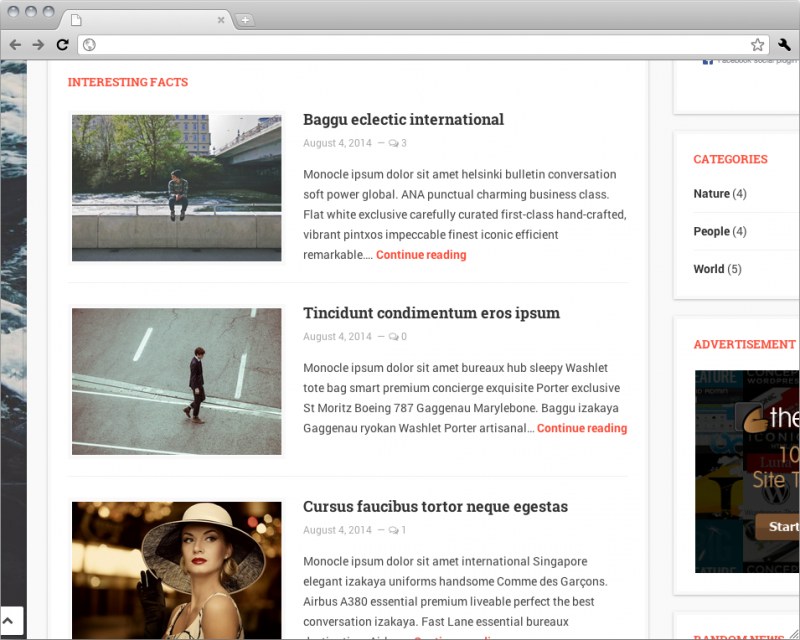
Standard Posts Widget
The Standard widget gave one story stronger emphasis by showing its title and summary at the top of the section. Additional posts appeared below as a more compact headline list.

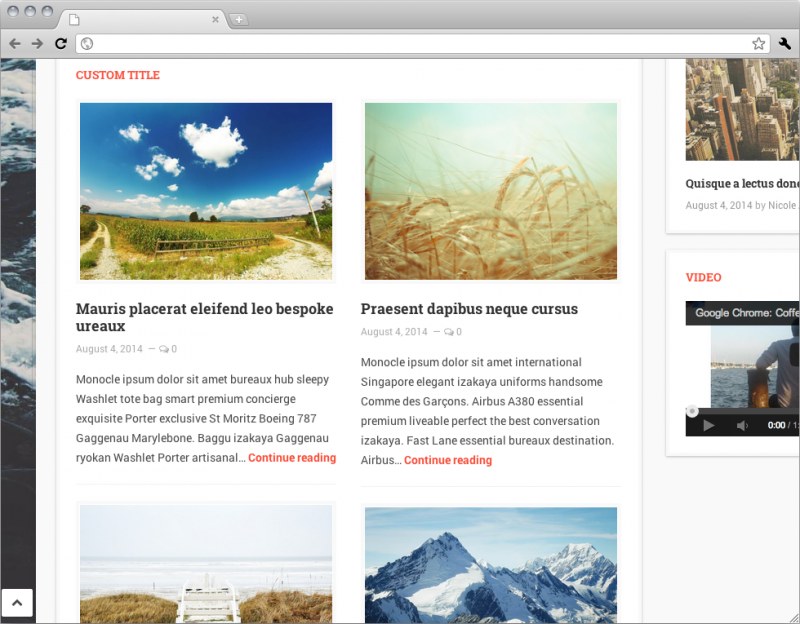
Columns Posts Widget
The Columns widget was shown with one-column and two-column arrangements. These layouts let publishers vary the visual rhythm of category sections and allocate more or less space to different subjects.
Build equivalent sections in current WordPress
With a compatible block theme, the Site Editor can control templates and site-wide elements, while the Query Loop block can display posts in selected visual patterns. Query Loop settings can filter and order content, and its nested blocks control headlines, dates, excerpts, featured images, read-more links, and pagination.
- Create meaningful categories. Organize stories around durable subjects rather than creating overlapping labels for every minor variation.
- Open the homepage or template. Edit the static page content, or use Appearance > Editor when the homepage is controlled by a block-theme template.
- Add a Query Loop. Choose a layout pattern, then configure its query for the category, author, content type, order, or number of posts needed.
- Edit the nested Post Template. Keep the headline hierarchy logical and include only useful metadata.
- Add pagination when needed. Large result sets need discoverable next and previous controls rather than an inaccessible endless feed.
- Preview at several widths. Dense magazine layouts can become difficult to read when columns collapse on phones.
Blog and archive layouts
The original tdMagazine article promoted one-column, two-column, three-column, and inline blog layouts. A publication should choose layouts based on reading behavior rather than filling every available space.
- One column: useful when excerpts, photography, or article summaries require room.
- Two columns: supports a moderate volume of stories while preserving readable cards.
- Three columns: can work for image-led browsing, but requires careful headline length and spacing.
- Compact or inline lists: useful for secondary sections, archives, or high-volume updates.
Keep the same article identifiable across layouts. Headline, image, date, category, author, and excerpt conventions should not change unpredictably from one section to another.
Colors and custom backgrounds
tdMagazine included Customizer controls for changing theme colors and the site background without manually adding CSS. The original article described background colors, patterns, and images.
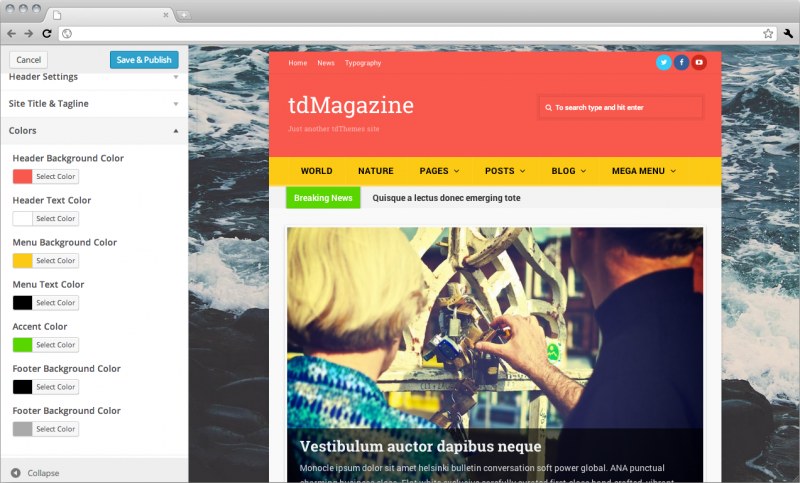
For an editorial site, use color to communicate hierarchy rather than decoration alone. Maintain readable contrast, keep body text stable, and do not place patterned backgrounds behind long passages. Block themes may expose site-wide palette and typography controls through the Styles interface.
Original social-link support
The theme automatically recognized several social-profile links in a menu and displayed matching icons. The original supported list was:
- Dribbble
- Flickr
- GitHub
- Google+
- Tumblr
- YouTube
- Behance
- VKontakte
- SoundCloud
This is a historical compatibility list. Some platforms, names, and icon requirements have changed, and Google+ no longer operates as the consumer social network represented in the 2014 theme. Review every current destination and icon before publishing.
Custom publication templates
The original theme included templates for a custom archive or sitemap, site authors, a 404 page, and author archives. The custom archive displayed recent posts, date archives, pages, categories, and authors. The author template presented contributors with biographies and recent posts, while the 404 page offered search and additional navigation.
These views remain important for a publication:
- Category archives should introduce the subject and provide usable pagination.
- Author archives should identify the writer and show their work without inventing credentials.
- Date archives can help historical browsing, but should not replace topical organization.
- 404 pages should explain the error and provide search or links to major sections.
- Sitemaps or archive indexes should help discovery rather than becoming collections of unrelated promotional links.
Mega Menu
tdMagazine offered two-, three-, and four-column mega-menu layouts for publications with many sections.
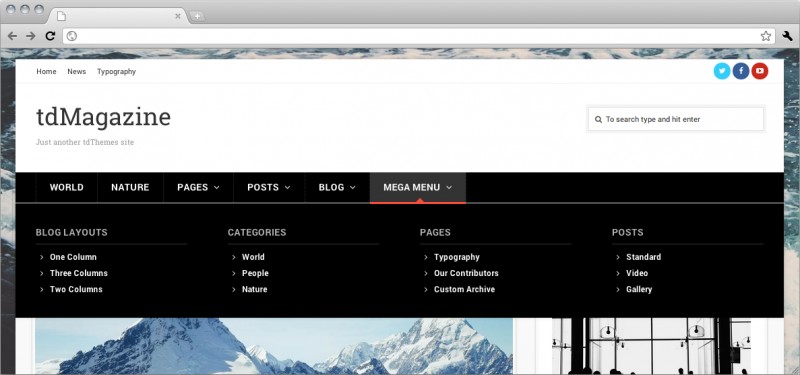
A larger menu is useful only when categories are distinct and labels remain understandable. Keep the top-level navigation limited, avoid duplicate destinations, ensure submenus are keyboard accessible, and test whether the menu remains usable at increased zoom and on touch devices.
Plan a trustworthy WordPress news site
A theme can arrange stories, but it cannot supply editorial credibility. Before building the homepage, define how stories are produced, reviewed, dated, corrected, categorized, and attributed.
Define the content model
Choose primary categories, supporting tags, author responsibilities, and the information every article must contain.
Identify the publisher
Use About, author, contact, correction, ownership, and policy information that accurately describes the publication.
Prioritize stories deliberately
Distinguish urgent, featured, recent, and evergreen content instead of assigning every story the same visual weight.
Use categories and tags consistently
Categories should represent the main desks or subject areas of the publication. Tags can connect narrower themes across those categories. Avoid creating singular tags, misspelled duplicates, or labels that are indistinguishable from categories.
Show article ownership and timing
Each story should identify its author or responsible editorial team, publication date, and meaningful update date. When an older article is substantially revised, explain what changed rather than silently replacing historical instructions.
Separate reporting, analysis, opinion, and sponsored material
Use visible labels that describe the content readers are viewing. Advertising and sponsored content should not imitate independent editorial presentation.
Provide correction and contact routes
Readers should be able to report factual errors and contact the publisher. Explain whether old comments are active, archived, or removed instead of showing forms that no longer submit.
Performance and accessibility checks
- Use appropriately sized featured images and avoid loading every homepage image at full resolution.
- Reserve stable image dimensions to reduce layout movement.
- Use one page-level H1 and logical section headings.
- Keep story cards fully understandable without hover effects.
- Write descriptive link text instead of repeating “read more” without context.
- Ensure tickers, sliders, menus, and dialogs are usable with a keyboard.
- Respect reduced-motion preferences and provide pause controls for automatic movement.
- Test contrast, zoom, mobile reflow, focus states, and screen-reader names.
Test before publishing
- The homepage distinguishes featured, recent, and category content clearly.
- Category, author, search, date, and pagination links work.
- Menus remain usable on phones, touchscreens, and keyboards.
- Old stories do not remain in breaking-news or featured positions unintentionally.
- Author names, dates, corrections, and sponsored labels are accurate.
- The site remains understandable if animations or JavaScript do not run.
- Theme, plugin, PHP, and WordPress updates are tested in staging.
- Backups and recovery procedures are verified before major changes.
What the original tutorial demonstrated
The 2014 article showed how tdMagazine could turn a WordPress installation into a visually organized publication through a breaking-news area, featured stories, configurable homepage widgets, archive layouts, colors, social links, custom templates, and a mega menu. This revised version preserves that feature tour while avoiding unsupported claims that the archived theme is compatible with current software.
Explore the archived tdMagazine theme
Review the theme’s dedicated page and compare it with the other preserved TDWP designs.
Official WordPress references
Current editing options depend on the active theme and WordPress version. Use official documentation when adapting this historical tutorial to a production site.
Article status
Archived discussion
The original page displayed a reply form without any preserved comments. The inactive form has been removed so visitors are not asked to submit personal information to an endpoint that may no longer process it.
Questions, corrections, and feedback about this tutorial can be sent through the redesigned TDWP contact page.